
Performance and Reliability Report
Simulate many online users and message flows to evaluate system capacity.
OpenIMSDK stress and reliability testing
Terminology and scope
- OpenIMSDK: The complete open-source project umbrella, consisting of the client SDK (OpenIMClientSDK) and the backend server (OpenIMServer).
- ChatServer: The business extension server. Unless stated otherwise, the core performance benchmarks on this page evaluate OpenIMServer without ChatServer.
- Application administrator: Administrative accounts used for platform management API calls (such as issuing tokens and executing batch migrations).
- Application business backend: The host application backend connecting to OpenIMServer, handling custom business logic and integrating via REST APIs, webhooks, or SDK events.
Test methodology
OpenIMSDK provides embeddable instant messaging infrastructure rather than a pre-packaged consumer chat application. Because OpenIMClientSDK core logic is implemented in Go via openim-sdk-core, deploying thousands of physical mobile devices for repeatable testing is impractical. These benchmarks use automated test harnesses to simulate large fleets of concurrent online clients and continuous message traffic to quantify system capacity, delivery reliability, and end-to-end latency.
Two coordinated benchmark tools were used:
- Test Program A:
openim-sdk-core/integration_test(reliability, latency, and state consistency verification) - Runs
openim-sdk-coreinstances to emulate full OpenIMClientSDK behavior, validating the complete message receipt, decryption, and local SQLite storage pipeline. - Test Program B:
openim-sdk-core/msgtest(stress and throughput generation) - Focuses on concurrent logins and high-volume message publishing to generate realistic peak traffic loads.
Recommended workflow: Use msgtest to generate background connection and throughput load, and use integration_test to perform sampled statistical validation of delivery reliability and round-trip latency.
Metrics definitions
- Reliability: Message delivery rate, defined as the percentage of messages published by senders that are successfully received and acknowledged by recipients.
- Latency: End-to-end elapsed time from the moment Client A creates and dispatches a message until Client B successfully receives and persists it locally.
Test environment
- Server 1: Ubuntu 22.04.2 LTS, 16 vCPUs, 64 GB RAM, 150 GB HDD. Hosts OpenIMServer and infrastructure dependencies (MongoDB, Redis, Kafka, Etcd, MinIO) and runs Test Program B. Test Program A can also run from
/dev/shmshared memory. - Server 2: Ubuntu 18.04.5 LTS, 4 vCPUs, 8 GB RAM, 40 GB HDD. Runs Test Program A from
/dev/shmshared memory. - Service scaling: In
open-im-server/start-config.yml, workers were scaled toopenim-push: 8andopenim-msgtransfer: 8. Other microservices ran as single instances.
Test scenarios and results
Test 1: Baseline load with 200 users
Test Program A simulates 200 users (100 logging in immediately and 100 logging in gradually), exchanging messages across friend chats and small groups.
Command:
go run main.go -lgr 0.5 -imf -crg -ckgn -ckcon -sem -ckmsn -u 200 -su 10 -lg 2 -cg 2 -cgm 5 -sm 5 -gm 5 -regDeployment: Test Program A runs in shared memory /dev/shm on Server 1.
| Metric | Result |
|---|---|
| Test objective | Validate delivery reliability and latency in small-team communication |
| User count | 200 registered users (100 immediate logins, 100 staggered logins) |
| Group topology | Each user belongs to 0–10 normal groups of 5 members each |
| Message throughput | Peak 40 msgs/sec |
| Total messages delivered | 112,350 messages |
| Delivery reliability | 100% (zero message loss) |
| Average latency | 0.231 s |
| Maximum latency | 1.703 s |
Test 2: 50,000 concurrent online users with small groups
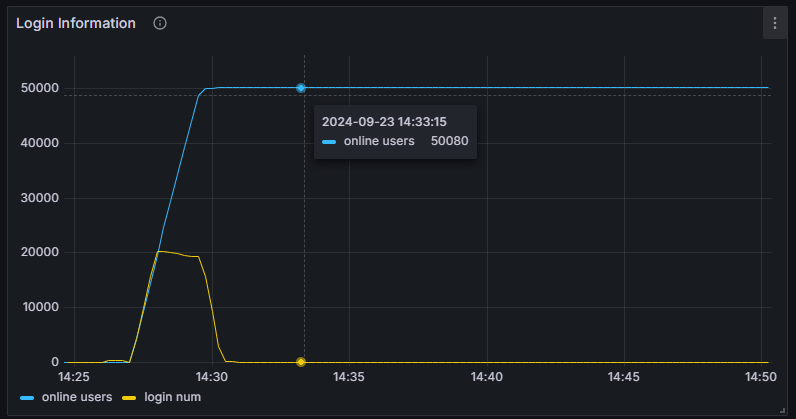
- Test Program B simulates 50,000 active online users publishing random messages to generate background system load.
- Test Program A simulates 100 users to perform sampled statistical measurements of delivery reliability and latency.
Benchmark commands:
# 1. Register 100,000 user accounts (Program A)
go run main.go -reg -u 100000

# 2. Maintain 50,000 concurrent connections generating load (Program B)
go run main.go -s 49500 -e 99500 -c 100 -i 500 -rs 1000 -rr 1000

# 3. Sample delivery reliability and latency (Program A)
go run main.go -lgr 0.8 -imf -crg -ckgn -ckcon -sem -ckmsn -u 100 -su 3 -lg 0 -cg 4 -cgm 5 -sm 100 -gm 100 -msgitv 1500 -test
Deployment: Test Program A runs in /dev/shm on Server 2; Test Program B runs on Server 1. The full benchmark test duration is approximately 4 hours.
| Metric | Result |
|---|---|
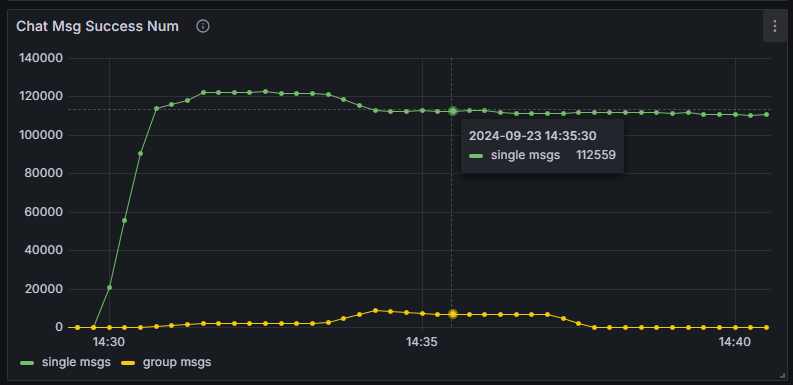
| Background stress load | 50,000 concurrent online users, ~1,700 msgs/sec |
| Sampled user pool | 100 users (80 immediate logins, 20 staggered logins) |
| Sampled group topology | Each user belongs to 0–20 normal groups of 5 members each |
| Sampled message send rate | Peak 54 msgs/sec |
| Sampled message volume | 170,800 messages |
| Delivery reliability | 100% (all sampled messages successfully delivered) |
| Sampled average latency | 0.202 s |
| Sampled maximum latency | 3.641 s |
Server resource utilization (Test 2)
Concurrent online connections:
Message throughput (metric indicates inbound message count per minute):
CPU utilization breakdown:
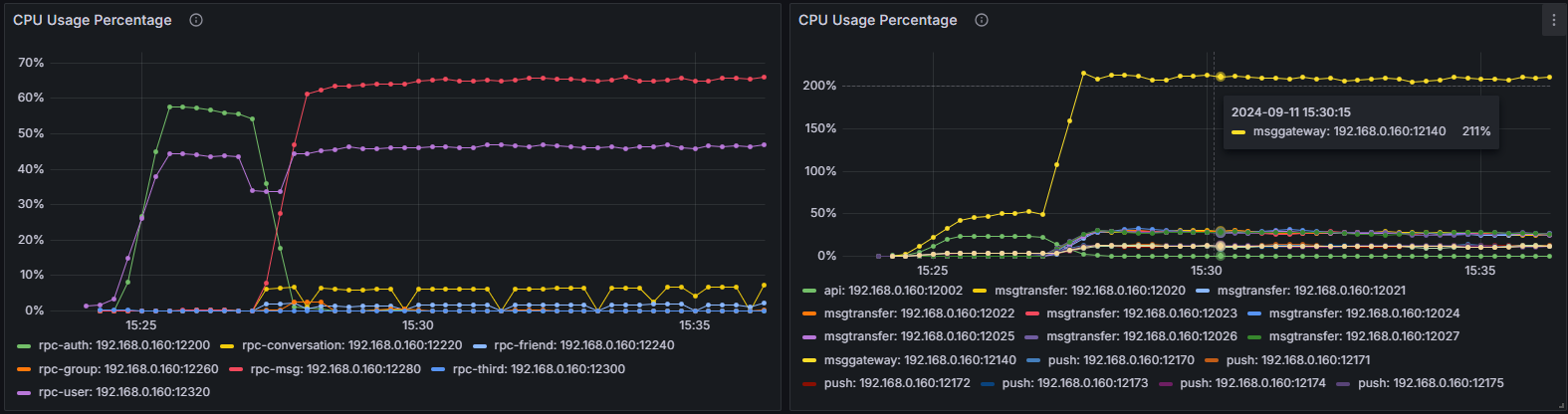
| Process | CPU utilization |
|---|---|
| openim-msggateway | 210% |
| mongo | 100% |
| kafka | 84% |
| redis | 67% |
| openim-rpc-msg | 56% |
| openim-msgtransfer | 27% × 8 |
| openim-push | 13% × 8 |
| Other OpenIMServer services & components | 65% |
| Total | 902% (approx. 9 cores) |
Resident memory footprint:
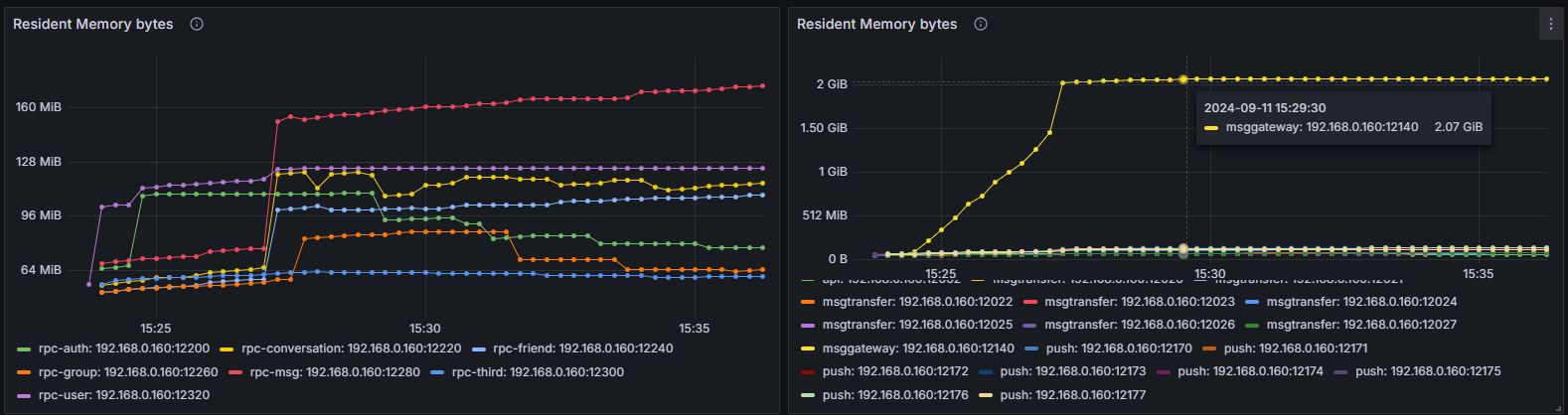
| Process | Resident memory |
|---|---|
| openim-msggateway | 2.1 GiB |
| mongo | 717 MiB |
| kafka | 1.1 GiB |
| redis | 85 MiB |
| openim-rpc-msg | 162 MiB |
| openim-msgtransfer | 74 MiB × 8 |
| openim-push | 126 MiB × 8 |
| Other OpenIMServer services & components | 457 MiB |
| Total (all OpenIMServer services & components) | 6.986 GiB |
*Note: Figures are approximate process measurements and exclude Docker bridge container packet routing overhead.*
Test 3: 50,000 concurrent users with 50,000-member supergroups
- Test Program B generates background load with 50,000 concurrent online users sending random messages.
- Test Program A simulates 20 users (16 logging in immediately) sending messages to friend chats and 10 large groups with 50,000 members each.
Benchmark commands:
# Register 100,000 users
go run main.go -reg -u 100000

# Maintain 50,000 online connections
go run main.go -o 50000 -s 49500 -e 99500 -c 100 -i 500 -rs 1000 -rr 1000

# Measure message integrity and latency in 50,000-member groups
go run main.go -lgr 0.8 -imf -crg -ckgn -ckcon -sem -ckmsn -u 20 -su 3 -lg 10 -cg 0 -cgm 5 -sm 0 -gm 10
Deployment: Test Program A runs in /dev/shm on Server 2; Test Program B runs on Server 1.
| Metric | Result |
|---|---|
| Background stress load | 50,000 concurrent users, ~1,700 msgs/sec |
| Sampled user pool | 20 users (16 immediate logins, 4 staggered logins) |
| Sampled group topology | 10 large groups of 50,000 members each (500 online per group) |
| Sampled message send rate | Peak 32 msgs/sec |
| Sampled message volume | 24,000 messages |
| Delivery reliability | 100% (zero message loss) |
| Sampled average latency | 0.022 s |
| Sampled maximum latency | 1.664 s |
Benchmark analysis
Under the tested hardware and architecture profile, OpenIMServer reliably sustained 50,000 concurrent online WebSocket connections and multiple 50,000-member supergroups. Under continuous throughput of ~1,700 messages per second, measured delivery reliability reached 100%, average round-trip latency was below 1 second, and peak latency remained under 3 seconds.
These benchmark figures reflect specific releases, hardware profiles, deployment topologies, and workload patterns, and should not be interpreted as absolute capacity guarantees for all production deployments. Perform load testing in your target staging environment with representative message sizes, user traffic patterns, storage engines, and high-availability configurations before launch.
Recommended production specifications
For a baseline deployment supporting 100,000 registered users, a 10% daily concurrent online rate (~10,000 CCU), 50,000-member supergroups, and sustained throughput of 600 messages per second:
| Resource | Recommended minimum specification |
|---|---|
| RAM | 16 GB |
| CPU | 8 vCPUs |
| Network bandwidth | 10 Mbps dedicated |
*Calculations assume an average message payload size of 2 KB. Actual requirements depend on payload content; plain-text chat packets typically average ~700 bytes. For configuration parameters, execution flags, and step-by-step instructions on running the benchmark suites, see Benchmark tools.*